Focused Learning in Snakes
We learn through creativity not through consumption so our focused learning for first term was ‘Numeracy In Action‘.
We covered;
- Size and measurement;
- Maths concepts in our everyday activities;
- Counting and number recognition; and
- Engaged learning activities
Children start learning numeracy skills from the time they’re born.
This learning happens from watching and experiencing everyday play and activities.
For instance, it happens when your child;
- Hears you counting;
- Decides how many slices of apple they want; and
- Recognising numbers and shapes on objects like clocks, phones and books.
Size and measurement.
This develops through everyday activities;
- Comparing things of different sizes – ‘big’, ‘small’ and ‘medium’
- Grouping things together and talks about ‘same’ and ‘different’
- Using words to describe where things are – ‘over’, ‘under’ and ‘next to’
- Setting the table with the number of plates and cutlery that match the number of people eating;
- Pouring water in a bottle half way;
- Helping with the shopping and counting money to pay; and
- Dividing food into equal shares.
When you talk with your child about maths concepts in your everyday activities, it helps your child understand how and why maths is useful. For instance;
- Big and small teaches size;
- High and low teaches height;
- Heavy and light teaches weight;
- Fast and slow teaches speed;
- Close and far teaches distance; and
- First, second and last teaches order.
Counting & Number Recognition
Providing a variety of learning activities is key to meeting children’s needs as a collective group because children learn differently.
There are 8 different learning styles ;Visual, auditory, kinesthetic, Linguistic, analytical, social, solo and nature learners.
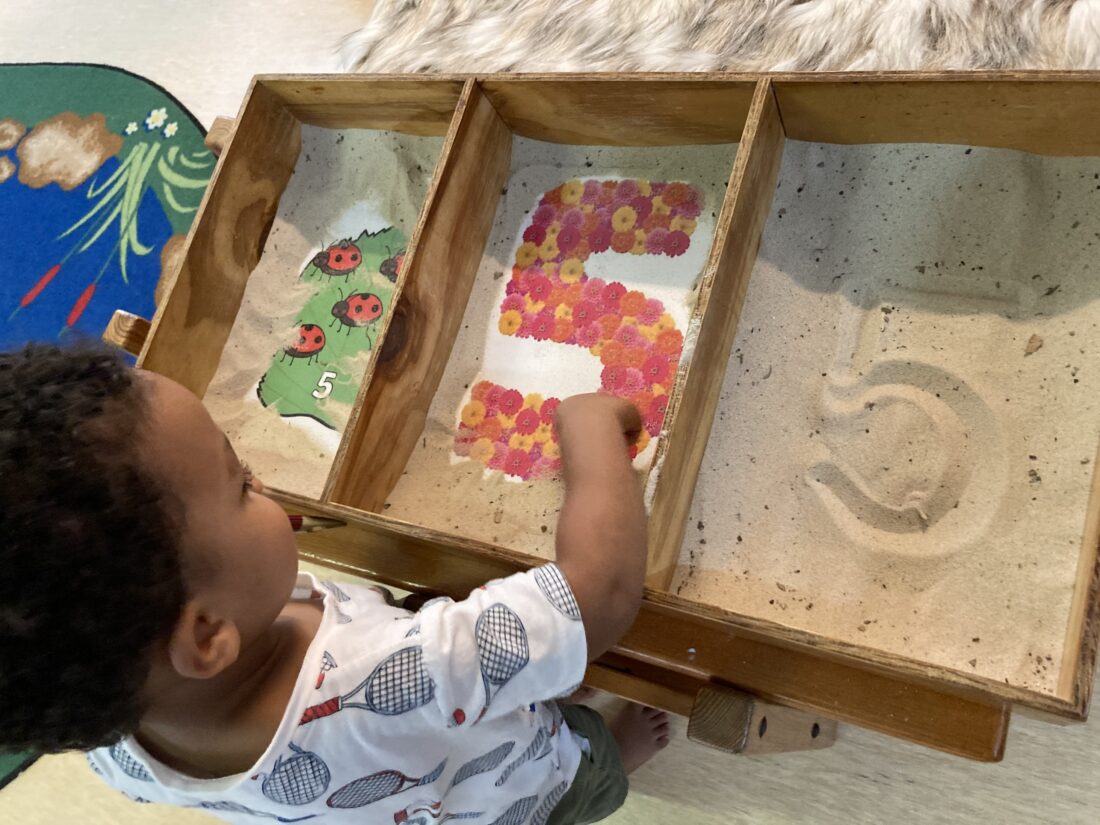
Our favourite visual, kinesthetic, linguistic, solo, nature activity at the moment is our Sand Tray.
Our tray is sectioned into 3. The object of this activitiy is to uncover what is under the sand and to trace , write or count the number of the week.
Some other skill building activities are;
- Reading stories with numbers, like ‘Goldilocks and the three bears’;
- Playing counting and sorting games;
- Singing number songs and rhymes; and
- Using tone of voice to describe concepts.
Changing our tone takes children on a visual, unlimited journey, which stimulates their visualization skills. Use a deep, loud voice to describe something big, or a soft, squeaky voice to describe something little. Try it and see their reaction.
Mimics
We talk, children mimic!
Talking out loud is how children learn.
- Everyday activities: Sounds like ‘Let’s put half of the bird seed here and half over there’ or ‘Let’s find matching socks’
- The environment: Sounds like ‘Look at the little bird over there’ or ‘That’s a tall tree’
- Food: Sounds like ‘Let’s have two pieces of banana’ or ‘How many cups do we need?’
- Time: Sounds like ‘7 pm, time for bed’
- Shapes and patterns: Sounds like ‘Let’s look for all the triangles’.
Most importantly, we make these everyday numeracy activities and experiences playful and relaxed so that they’re fun and enjoyable.
Home Play
How can I consolidate at home ? I hear you say!
Here are some ideas for Discussion, everyday activities, play and engaging numeracy books, to get you started;
Discussion
- Use maths concepts to describe what you and your child are seeing and doing together. Like, ‘Look at the fast cars’ or ‘This bag is heavy’;
- When you’re preparing food, talk through what you’re doing. Like, ‘I’m cutting this orange in half’ or ‘Let’s share these sultanas… one for me and one for you’;
- Point out and name the numbers you see, like the numbers on mailboxes, buses and road signs;
- When you’re out and about, talk about what’s near or further away. Like ‘Let’s sit on that bench nearby to have our snack’ or ‘It’s quite far to the lake; and
- Talk about activities that happen at certain times of the day. Like, ‘We eat breakfast at 7 am’, or ‘Let’s go to the park before we have dinner at 6 pm’.
Everyday activities
- Make counting part of your everyday life. Count shells at the beach, fruit at the shop, trees on the street;
- When you’re out, encourage your child to describe or compare shapes of leaves, colours of flowers or sizes of birds;
- Go for a walk down your street and point out how each house or block has a number in a series. Guess the number of steps between one house and the next;
- Use a growth chart or marks on a wall to measure your child’s growing height, and describe to your child what you’re doing; and
- Involve your child in cooking. Your child can help stir, pour, fill and mix. This helps your child get familiar with concepts like counting, measuring, adding and estimating.
Play
- Go for a nature walk and let your child gather a mix of leaves, sticks, pebbles and other natural items. Your child can sort them into groups based on size, colour and shape;
- Sing songs and read books with repeating, rhyming or rhythmic numbers. This will help your child understand patterns;
- Play simple board games, card games and puzzles with shapes and numbers, like ‘Snap’, or matching pairs or dominoes;
- Engage with outside games like ‘I spy’, hopscotch, skittles and ‘What’s the time Mr Wolf’;
- Play or sing music at different speeds. Your child can dance, jump or shake musical instruments to slow or fast songs. Sing nursery rhymes slowly and then speed up;
- Race toy cars and talk about which came first, second or third;
- Help your child to arrange their toys in order from shortest to tallest; and
- Encourage your child to pack away their toys, counting as they go. This will strengthen counting skills but will also develop an understanding of order and structure.
Recommended Book list
Featuring numbers, counting, shapes and sizes;
- At the beach I see by Kamsani Bin Salleh
- Counting kisses by Karen Katz
- One woolly wombat by Kerry Argent
- Soup day by Melissa Iwai
- Ten little dinosaurs by Mike Brownlow
- Ten little fingers and ten little toes by Mem Fox
- Ten little ladybugs by Melanie Gerth
- The very hungry caterpillar by Eric Carle
- We all sleep by Ezekiel Kwaymullina.
That’s all this month from Miss Roshin, Miss Coby and the Jomgwongs
Also please follow our Facebook and Instagram Pages and stay up to date.